
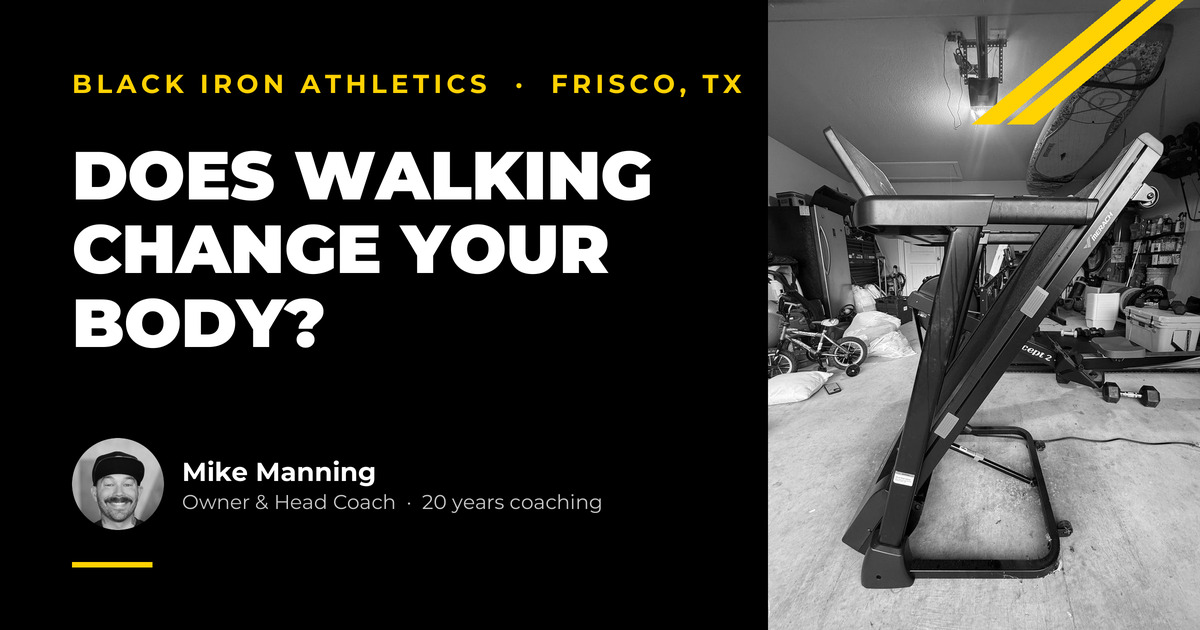
I get a version of this question every month. Do steps actually change anything, or is walking just something people do so they can tell themselves they did something?
Short answer: they matter, they aren’t the whole story, and they’re probably the easiest thing you’re not doing yet. Here’s the longer one.
Steps Are Mileage, and Mileage Is Expenditure
When we’re looking at metrics for changing someone’s body composition, steps are an important part of the picture. They don’t tell the entire story, but they add up to what we call your total daily energy expenditure. That number is essentially your mileage throughout the day. Not just your metabolic rate sitting still, but what kind of output you actually have.
So the first thing I want to know is what your day looks like. Are you in an active job, on your feet, walking a job site all day? Or do you have a desk job with a lot of sitting, a lot of downtime, and not much movement? Those are two different people who need two different plans, and you can’t build either one without knowing which one you are.
That balance between what your total daily energy expenditure is and what your intake is, that’s really the key to any body composition change. Everything else is detail.
What Ten Thousand Actually Takes
Take the desk guy. If you’re having a hard time clearing three to five thousand steps in a day, getting to ten thousand is a very doable goal, and it means doubling or tripling your mileage. For that person, that’s a massive change, and it costs you almost nothing except time.
Here’s the math, and it’s easier than people expect. Walk at two or three miles an hour for an hour and you’ve covered two to three miles. Stack that on the three to five thousand you’re already getting without trying, and you’re past ten thousand.
One hour. That’s the whole price.
Some of my favorite places to put it: the garage in the morning while I answer emails, after my wife and kids have left for the day. A walking pad under my standing desk while I work. Or after a meal, out with the family when it isn’t too hot, which does good things for your digestion on top of the mileage.
Why Walk It Instead of Running It
People ask me why they’d walk an hour instead of running it or doing a hard conditioning piece. It’s not about which one is better. It’s about which one is right for you today.
There’s no argument that running gives you a higher expenditure than walking for the same hour. None. But not a lot of people can run an hour straight, every single day, with no rest day and no break. That’s where intentional mileage that isn’t high intensity makes a real difference. Sustainability matters more than intensity when you’re talking about something you need to keep doing for years.
I Took the Path of Most Resistance for Twenty Years
I’ve gone down the road of unsustainability more times than I can tell you. I’m obsessed with fitness and movement, so much so that I own a gym and made it my life’s work to help everyday people become everyday athletes.
And I still spent a long time taking the path of most resistance, because my background in sports and in the Marine Corps told me that was what got results. I paid for it. Over and over.
What changed is that my pain levels kept climbing. I’m a disabled veteran, and I kept thinking I could outwork the mileage I put on my body when I was younger. It caught up to me. It catches up to everybody eventually. The only real question is whether we’re smart enough, humble enough, or honest enough to make the changes our body is screaming at us to make.
So a lot more of my time goes toward less intensity and better long-term results now.
Here’s the part I’ve been saying to people lately. I should be in the best shape of my life right now, as an adult. I’m the most disciplined I’ve ever been. I have the most resources. I’m smarter than I was and I’ve got more experience than I did at twenty-five. So why would the best shape of my life be behind me instead of in front of me?
That’s what I’m chasing now. Not a competitive goal, not something insane I can say I finished no matter what it cost me. An example, for my community, for my family, and honestly for me, of what health actually looks like in the back half of a life.
When the Scale Doesn’t Move
Say you do all of it. Ten thousand a day, every day, for a month, and nothing changes. What happened?
First, you’re not worse off. You made an effort to put movement first, and that was never the wrong call.
Second, and this is the useful part, you just learned something specific about yourself. If your expenditure went up and your weight didn’t come down, your intake isn’t where you think it is. Whatever activity you added got negated by the calories going in.
Usually I can tell you exactly where it went, too. Somebody adds the hour, and then decides they’ve earned a treat. It’s hot out, they just walked for an hour, the ice cream feels like a fair trade. Calorically, you just undid the work you put in and erased the deficit you built.
So walking ten thousand steps a day is never going to put you in a bad position. I’d argue the opposite, it’s only good for you. But it also gives you a clean read on your intake, and that read is the thing to work on next. Creating an intentional deficit with your food.
Get those two in line and it’s thermodynamics. You will lose weight. It becomes a matter of time and consistency. And if you’ve got a medical reason the scale won’t move, that’s a conversation for your doctor, not your coach.
“I Don’t Have an Hour”
This is where most people check out, so let me push back on it.
That hour can be time with your kids. When I head out to the garage for a walk or a run, my boys come out and tell me they want to work out too. Most of what they do is pick things up and throw them around. They sit on the rower and play. Not much actual exercise is happening out there. That was never the point. The point is that they see me making the effort.
And I’m still there. Mileage on a walking pad while I work, or a run in the garage while the kids ride bikes in the driveway, means I’m not gone for an hour. I’m present. That’s a big part of why I keep a walking pad and a treadmill at the house.
The other version is habit stacking. Answer your emails while you walk. Take the call you don’t have to talk on. Sit through the meeting where you’re one of nine people on mute, and walk the whole thing.
So when somebody tells me they don’t have an hour, I’ll challenge the expectation and I’ll challenge the priority. Usually the hour is already there. It’s just currently spent sitting down.
What Counts for the Challenge
One clarification, because it’s come up more than anything else on the board this month.
For your total daily energy expenditure, every step counts. All of it. Every bit of your movement matters, whether your tracker caught it or not. More movement is always in your favor, as long as it’s sustainable and easy on your body. Don’t mix that up.
For our September challenge, only intentional mileage counts. Walking, jogging, running, or a mix of the three. Not because the steps you get around the house and the office don’t matter, because they always do and they always will. But for the purpose of logging it and pushing yourself against the board, we’re counting the mileage you went out and got on purpose.
The Gear Question
The other thing I keep getting asked this month: what treadmill or walking pad should I buy for the house?
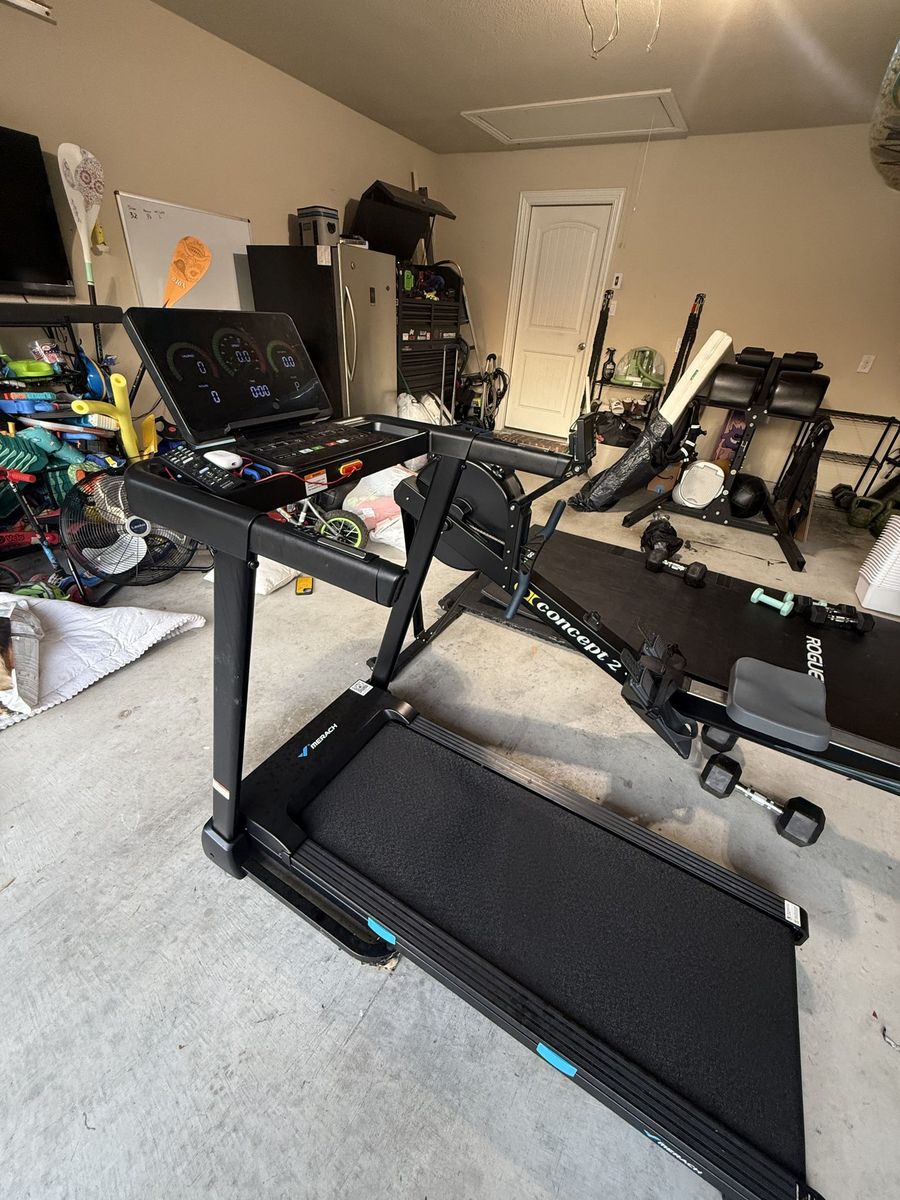
Mine, in the garage. A hundred-plus miles on it now.
I own a MERACH T12 Pro. I paid for it with my own money, it lives in my garage now after a stint under my standing desk, and I’ve put well over a hundred miles on it. One real problem in all that time. The belt stretched in the Texas garage heat and started skipping, which two tension screws and about ninety seconds fixed. That’s the entire complaint list. The full review lives on Every Dad Carry, my gear review site.
Honest disclosure, and it goes both directions. Every Dad Carry is my site, some of the links on it are affiliate links, and the MERACH link further down is one as well. I earn a commission if you buy through either, at no extra cost to you. Separately, MERACH is running a sale from September 15 through 30. The T12 I actually own is not in that sale. The walking pad that is in the sale is one I’ve never stood on, so I’m not going to tell you how it feels underfoot.
Which makes my answer narrower than most people want it to be. I’ve got a hundred-plus miles on this company’s build quality at a price that made the bet easy, and I’d buy from them again. Past that, go read reviews written by people who own the exact thing you’re considering. If you want to see what they carry, MERACH’s store is here, and the sale runs through September 30.
And to be clear about it: you don’t need any of that. A sidewalk is free. A machine only matters because it’s ten steps away on the day the sidewalk is twenty minutes away.
The Easiest Lever You Have
We help everyday people become everyday athletes. That doesn’t get built in the one hour you spend with us. It gets built in the twenty-three hours after it.
Walking won’t do the hard work for you. Nothing does. But it’s the easiest lever you’ve got, it’s sustainable, it’s easy on your body, and most of you aren’t pulling it yet.
Go get the mile.

Your Strongest Decade Can Still Be Ahead of You
Book a free consultation and we’ll build an honest plan for it — your goals, your history, your schedule, zero pressure. Explore our programs or see how easy it is to get started.
Book a Free ConsultGet Tips Like This in Your Inbox
Subscribe for weekly training, nutrition, and supplement tips from the coaches at Black Iron Athletics.
Subscribe